
Cherokee County Civil Docket Searches
The Cherokee Clerk Case Search calls its public product the Docket Feature. Civil Search runs on Case #, Party Name, CSE number, and system wide search. A result may list parties, court dates, judge assignment, posture, and an expandable docket. Treat the display as a convenience view. It is not the full civil file.
Pick the civil category first. Superior and State civil cases run through the Clerk of Courts route. Magistrate claims and dispossessory matters take a limited-jurisdiction path. When a case number fails, the official instructions suggest a fallback. Search the party as Last Name, First Name. A city or federal case may simply not appear in the county civil search.
Here is a careful civil docket lookup:
- Open the Clerk's Docket Feature and select Civil Search or the court category that fits the case.
- Enter the Case #, Party Name, CSE number, or system wide option shown in the official search instructions.
- Try Last Name, First Name when a case-number search returns no expected result.
- Use the green additional-information control and the plus sign beside the case number to review the docket.
- Ask the Clerk for the filed document or certified judgment when a docket line is not enough.
The Clerk's official forms index displays the civil forms connected with this search route.
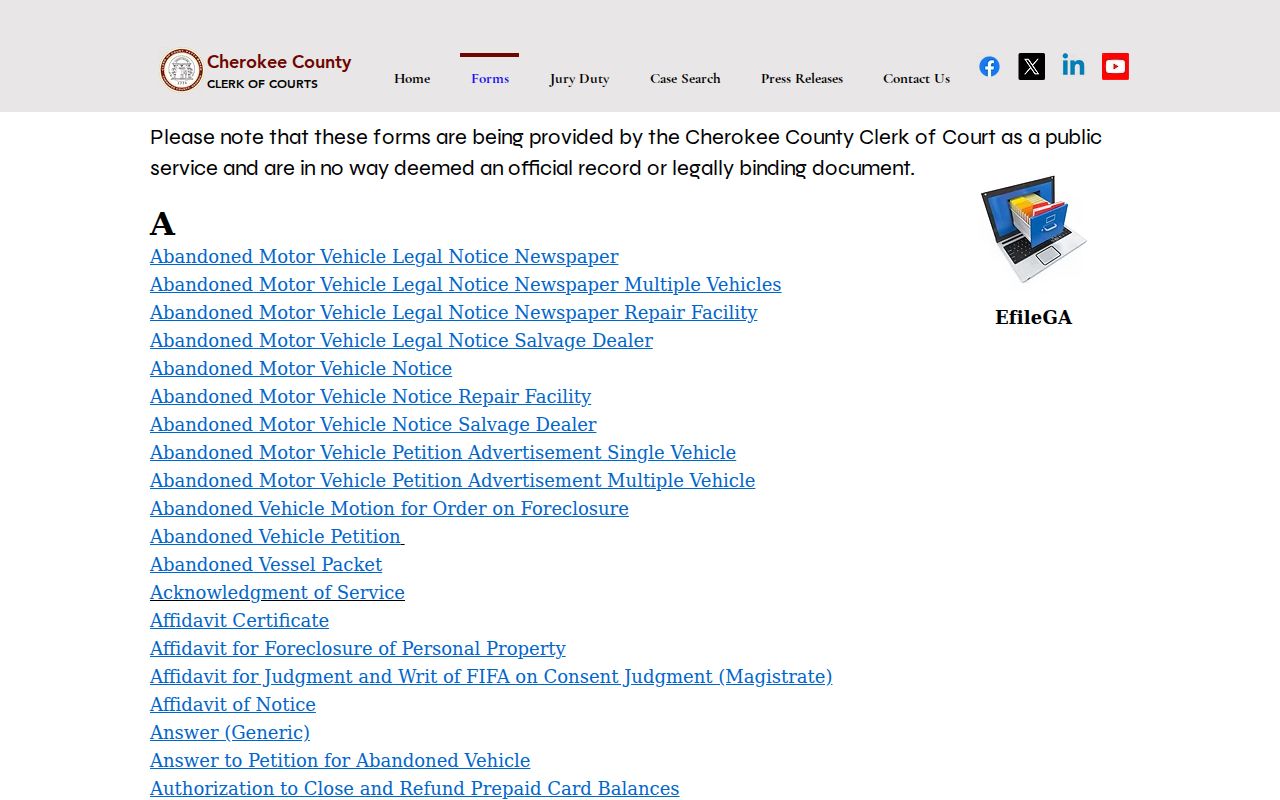
That index covers civil answers, dismissals, judgments, garnishments, protective-order forms, payment information, and other filing materials. A form list is not a docket result, though. For field-by-field details, turn to the Cherokee County Docket Search route.
Cherokee Civil Search Fields
Civil Search offers fewer fields than a filing form. Case # takes the clerk identifier. Party Name searches indexed participants. The public landing page and instructions expose a CSE number label without defining its format. System wide search widens whichever choice you selected. Search submits the query, Clear resets it, and a green control with a plus expander opens more detail after a result appears.
The public instruction PDF does not say which fields are required. Nor does it publish one universal Cherokee case-number format. Keep that gap in mind. Never invent a number pattern for a request; copy the number exactly as it appears on a filed notice, summons, order, or clerk communication.
| Field or control | Civil search use | Research limit |
|---|---|---|
| Case # | Looks for the clerk-assigned identifier, shown as Case #. | No universal public format is stated. |
| Party Name | Searches an indexed plaintiff, defendant, petitioner, respondent, or other party. | Try Last Name, First Name if a number search fails. |
| CSE number | Uses the displayed civil-search label. | The public instructions do not explain its format. |
| System wide search | Broadens the category according to the official instruction choice. | It is not a single statewide public database. |
| Search and Clear | Submits the search or resets the entered fields. | They do not create or certify a case record. |
| Plus and green controls | Expand a found case or open additional information. | Blocked pleadings can still be absent from the remote view. |
Does a result look close? Check it against the court, party names, and case style. A docket match does not mean every document in the case is available online.
Civil Dockets: What They Show
A civil docket is the register of a matter's filings, motions, settings, orders, judgments, and disposition activity. It tracks what was filed and when. The Clerk's public display may show parties, judge assignment, dates, and overall posture. The complaint, answer, motion, exhibit, order, or judgment itself is a separate document. It sits behind a docket entry.
Cherokee's Civil and Domestic Information Form shows how much detail enters the filing side. It requests court and county. It also asks for a clerk-use filed date and case number, party names, attorney or self-represented status, case type and subtype, related case numbers, redaction certification, interpreter language, and accommodation needs. The docket will not display every one of those filing-side fields.
| Case number and style | The clerk identifier and case caption used to connect filings and later dispositions. |
|---|---|
| Parties | Plaintiff, defendant, petitioner, respondent, and related party fields entered in the case. |
| Filings | Complaints, petitions, answers, motions, briefs, exhibits, subpoenas, and other filed papers. |
| Settings | Civil non-jury, domestic, adoption, Pro Se Civil, jury, motion, or other court calendar events. |
| Orders and judgment | Rulings, final judgments, dismissals, dispositions, and post-judgment actions recorded by the clerk. |
| Disposition | The outcome category and date recorded on the docket or the separate disposition form. |
A docket line tells a reader what was recorded. To see the official paper or electronic document behind it, submit a copy request.
Cherokee Civil Court Jurisdiction
Superior Court is Cherokee's general civil court. It holds exclusive jurisdiction over divorce, equity, and title-to-land matters. Its civil docket also covers contract, tort, real-property, domestic-relations, protective-order, adoption-related, and post-judgment activity. Those match the Clerk's filing categories. State Court offers a civil forum for many case types, concurrent with Superior where appropriate.
Magistrate Court takes first-tier civil claims, dispossessory matters, bad checks, and other limited-jurisdiction work. The official 2026 Georgia General Statutes Summary reports a change in the Magistrate civil-claim ceiling. It rises from $15,000 to $25,000 effective July 1, 2026. Confirm the current jurisdiction and filing amount with the court. The Clerk's fee page and statutory effective dates can change.
| Court | Civil docket emphasis | Clerk route |
|---|---|---|
| Superior Court | General civil, divorce, equity, title to land, domestic, tort, contract, and property matters. | Superior Civil at 678-493-6501 or the Clerk's Docket Feature. |
| State Court | A broad civil forum for matters within concurrent jurisdiction. | State Civil at 678-493-6555 or the local Docket Feature. |
| Magistrate Court | Limited civil claims, dispossessory, bad checks, and related first-tier matters. | Magistrate at 678-493-6431 and the current statutory limit. |
The fee schedule lists $218 for Superior and State civil filing and $61 for a general Magistrate or dispossessory filing. Those amounts shift over time. Jurisdiction and the filing fee are separate questions.
For the effective-date change, the 2026 Georgia General Statutes Summary is the official source.
What Cases Fill the Civil Docket
Cherokee civil filing categories get far more specific than the word “civil.” The official information form requests one case type and subtype. It spans both general civil and domestic choices. A category is a filing classification, nothing more. It predicts no outcome and does not tell a reader which remedy or venue is correct.
Common categories in the county form include:
- Automobile tort, general tort, medical malpractice, and product liability.
- Contract, garnishment, post-judgment matters, and civil appeals.
- Real property, injunction, mandamus, habeas corpus, and other writs.
- Adoption, family violence, restraining petitions, and other domestic relations matters.
- Dissolution, divorce, separate maintenance, alimony, custody, visitation, support, and modification.
- Magistrate civil claims, dispossessory cases, and bad-check matters.
Later, a docket may show an answer, motion, ADR referral, trial setting, or disposition that differs from the original case type. The Clerk's forms are clear on one point: public information is not legal advice about venue, jurisdiction, or which form to file.
The Civil Filing Form's Fields
The Cherokee general civil and domestic information page supplies the field list.
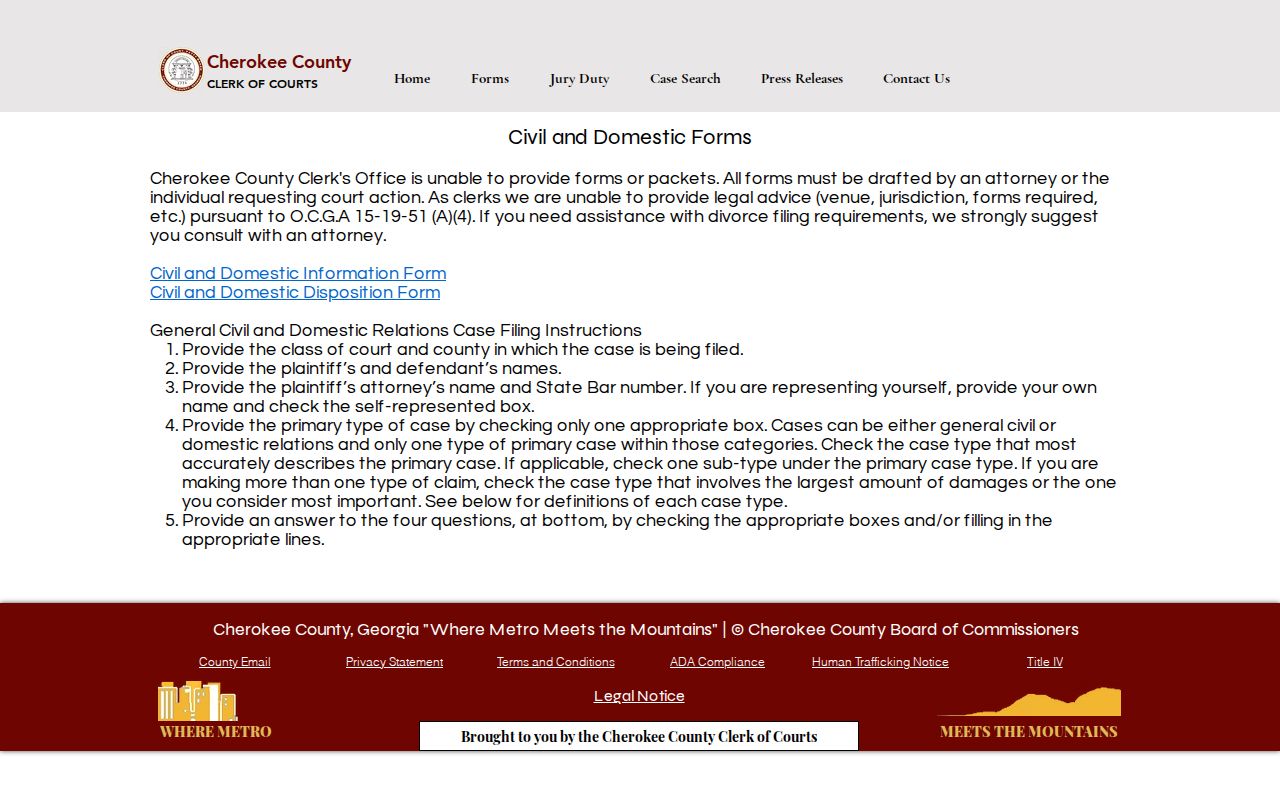
The civil filing form ties one case to a court, county, parties, attorney, case type, redaction statement, and access need. Every field shapes the record. Some details still stay off the docket. That is why a Cherokee County court docket search can find a case yet miss what a reader expected.
| Filing-side field | What the Cherokee form records |
|---|---|
| Court and county | Superior or State Court and the county receiving the filing. |
| Clerk use | Filed date and case number assigned or completed by the clerk. |
| Parties | Names with last, first, middle, suffix, and prefix spaces where applicable. |
| Attorney status | Attorney name and State Bar number, or a self-represented selection. |
| Case type | One general civil or domestic case type and subtype, plus related case numbers. |
| Access needs | Redaction certification under O.C.G.A. § 9-11-7.1, interpreter language, and disability accommodation request. |
The disposition form goes further, adding disposition date, case number, case style, reporting party, trial type, non-trial disposition or ADR, interpreter, and ADR referral fields. It records an outcome from one side. The docket line that notes the outcome is not the same thing, so read the two together.
Hearings on the Civil Docket
Civil settings come in several flavors. The labels include non-jury, domestic, adoption, Pro Se Civil, motion, ADR, and jury calendar blocks. The official Superior calendar sample carries those labels. It also warns that the calendar is for reference only. A case on a calendar proves nothing by itself. It does not show whether the matter was heard, continued, settled, or decided.
For calendar channels and setting fields, use the Cherokee County Court Schedule route. A date can also come from several places. Try a case notice, the Docket Feature, the judge's calendar clerk, or Court Administration. When the online calendar and a notice conflict, the current case-specific notice and the assigned clerk settle it.
Resets and continuances create new docket activity. A motion may be filed before a hearing. It can be ruled on at a setting or carried to a later date. An ADR referral can sit in a disposition field without resolving every claim. Read the event and the document together.
Calendar flow: Filing → Service and Response → Motion or ADR Setting → Trial or Hearing → Order, Judgment, or Disposition
Reading a Cherokee Civil Calendar Row
A calendar row packs in the month and date, time, event or docket code, judge initials, courtroom, Zoom marker, and special labels. Courtroom names 2A through 2D are location clues. A Zoom marker means a remote option, and only where the judge directs it. There is no universal county link.
Short civil labels take care. The public sample lists CVNJ, CVNJ GC, CVNJ Dom, Pro Se Civil, AD, and Adoptions. Not every abbreviation comes with a published expansion. So treat a code as a route to the full notice or docket entry, never as a legal conclusion.
- CVNJ
- A civil non-jury label captured in the official calendar sample.
- CVNJ GC
- A CVNJ label with a GC suffix. The exact local expansion is not published in the sample.
- CVNJ Dom
- A domestic civil non-jury label captured in the calendar sample.
- Pro Se Civil
- A civil calendar category, not a finding about a party or the case result.
- Adoptions
- A calendar subject that may carry access limits even when the calendar label is visible.
Note: Confirm the full event and current location with the assigned clerk when a static civil calendar row does not match a notice.
Mandatory Civil E-Filing in Cherokee
Odyssey eFileGA is the electronic filing route the Clerk links. It runs around the clock for filing access. An account or login is required. It is not the same interface as the anonymous public Docket Feature. A registered filing or document-access route may show material a basic docket search does not, subject to account, document, and access rules.
Cherokee's older Senate Bill 407 notice described mandatory civil e-filing, a public-access kiosk, and Re:Search access for broader Georgia records. That notice dates to 2019. Its fee figures are historical, not a current quote. Get current filing requirements, account steps, and fees from eFileGA and the Clerk.
State forms matter here. The Georgia Superior Court standard forms page lays out the state form route.
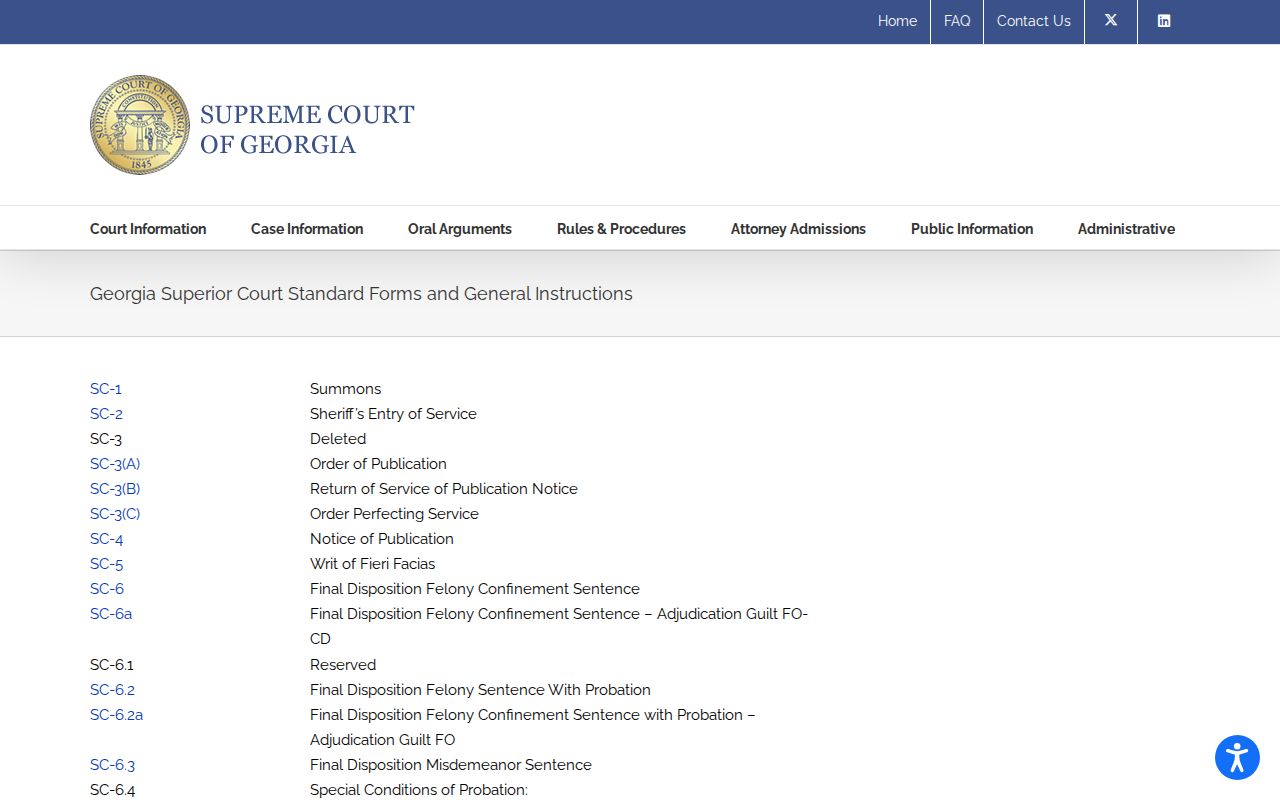
State forms and county filing instructions carry the filing itself. Afterward, the Clerk's docket is the record of case activity.
Re:Search is a different animal. The Clerk describes it as an account-based layer for attorneys and paralegals searching case information from 18 Georgia counties. Georgia Judicial Gateway E-Access is a provider directory. It is not one public Cherokee database.
Who Can See Civil Dockets
Georgia's Open Records Act favors inspection and copying. Exemptions, court orders, and filing rules still apply, though. Cherokee's online search notice says sensitive pleadings can be hidden from Internet viewing. A redacted public filing may be available. An unredacted version may sit under a seal request. Protected identifiers, adoption and domestic material, juvenile records, and sealed matters require a specific access route. Ask the clerk about it.
For a civil record request, gather the essentials first. Bring the case number, party names, document title, and date if known. Details speed things up. A remote search is not the only path. Alternatives include the public terminal at Suite G-170, the Superior Civil line at 678-493-6501, the State Civil line at 678-493-6555, and the mail copy route. The countywide administrative Open Records form is no substitute for the Clerk of Courts case-copy process.
Key rules:
Georgia Open Records Act, O.C.G.A. §§ 50-18-70 through 50-18-72 supplies the inspection and copying baseline, subject to exemptions.
O.C.G.A. § 9-11-7.1 is named in the civil filing form for protected-identifier redaction.
Uniform Superior Court Rule 21.6 governs filing-under-seal and protected information procedures.
Uniform Superior Court Rules 36.16 and 36.17 address electronic filing and sensitive information handling.
A docket entry, a filed pleading, and a certified judgment are three separate record products. Tell the clerk which one you need.